
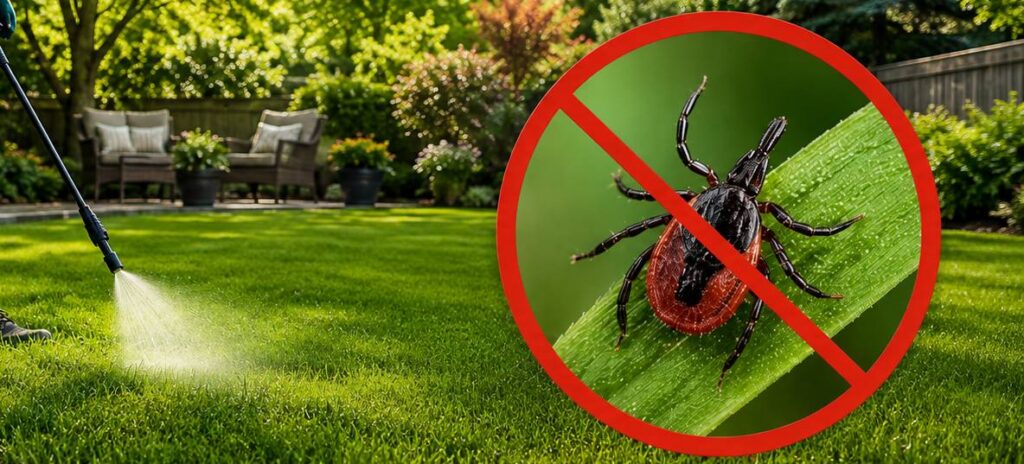
Eco-Friendly Tick Management
Ticks are found across Ontario, including Simcoe County. Bradford homeowners can reduce tick exposure without automatically treating every part of the yard.
An environmentally responsible approach focuses on reducing tick-friendly habitat, protecting the areas your family uses most, monitoring activity, and using targeted treatment only where appropriate.
Blacklegged ticks are present in Simcoe and Muskoka, and locally acquired blacklegged ticks have tested positive for the bacteria that causes Lyme disease.
Professional tick control can help identify higher-risk areas around a property and determine whether habitat changes, monitoring, or targeted treatment should be considered.
Where Are Ticks Common Around Bradford Homes?
Ticks are more likely to be encountered in areas with vegetation, shade, leaf litter, shrubs, and other conditions that help retain moisture.
Common tick habitat can include:
- Tall grass
- Wooded property edges
- Brush
- Leaf litter
- Dense shrubs
- Shaded fence lines
- Naturalized areas
- Wood piles and nearby vegetation
Public Health Agency of Canada guidance notes that ticks are often found around trees, shrubs, grass, wood piles, and piles of leaves. Dry, sunny areas are generally less favourable to them.
Ticks Do Not Jump or Fly
Ticks do not jump or fly toward people or pets.
Instead, they typically wait on vegetation and attach when a person or animal brushes against grass, shrubs, or other plant material.
This is why reducing contact with dense vegetation can be an important part of backyard tick prevention.
When Are Ticks Active in Bradford?
Tick encounters are most common during spring, summer, and fall. However, ticks can remain active whenever environmental conditions are favourable.
The Public Health Agency of Canada notes that ticks may be active whenever temperatures remain consistently above freezing and the ground is not covered by snow.
Bradford homeowners should therefore think of tick prevention as more than a mid-summer issue. Mild periods in early spring, late fall, and occasionally winter can still support activity.
Eco-Friendly Tick Prevention for Your Yard
Reducing favourable habitat can lower tick exposure without relying entirely on pesticide treatment.
1. Keep Grass Maintained
Mow frequently used lawn areas regularly and prevent excessive grass and weeds from developing around property edges.
Pay particular attention to:
- Wooded borders
- Fence lines
- Garden edges
- Areas around sheds
- Shaded corners
- Children’s play areas
Canadian public-health guidance recommends keeping lawns short and removing long grass and weeds as part of residential tick reduction.
2. Remove Excess Leaves and Brush
Accumulated leaves, brush, and plant debris can create shaded, moisture-retaining areas around a yard.
Remove excessive buildup around:
- Lawn edges
- Stone walls
- Wood piles
- Fence lines
- Sheds
- Wooded borders
Keep frequently used areas easier to inspect and maintain.
3. Allow More Sunlight Into Shaded Areas
Where practical, pruning dense shrubs or vegetation can allow additional sunlight and air movement into heavily shaded areas.
Public-health guidance specifically recommends pruning shrubs and trees where appropriate to allow sunlight to filter through.
Create Separation Between Lawns and Wooded Areas
A physical border can help create a clearer transition between maintained recreational areas and tick-friendly vegetation.
Materials can include:
- Gravel
- Wood chips
- Mulch
The Public Health Agency of Canada recommends a border of at least one metre between maintained lawn and shrubs, stone walls, or forested areas.
This can be particularly useful around paths, backyard seating areas, and spaces where family members regularly spend time.
Keep Play and Seating Areas Away From Dense Vegetation
When property layout allows, position frequently used spaces away from wooded borders and dense vegetation.
This may include:
- Children’s play equipment
- Patio furniture
- Picnic areas
- Outdoor seating
- Frequently used paths
Canadian guidance recommends placing patios, decks, and children’s play equipment in sunnier parts of the yard and away from yard edges where practical.
Reduce Wildlife and Rodent Attractants
Wildlife and rodents can carry ticks into residential environments. You cannot eliminate wildlife movement completely, but you can reduce conditions that encourage animals to remain close to the house.
Consider:
- Keeping garbage securely contained
- Cleaning spilled bird seed
- Avoiding outdoor food waste
- Reducing unnecessary outdoor clutter
- Managing rodent harbourage
- Keeping wood piles organized
Pets can also bring ticks into yards and homes, so pet owners should discuss suitable tick prevention with their veterinarian.
Use an Integrated Pest Management Approach
Integrated Pest Management (IPM) combines several prevention and control methods rather than automatically treating the entire property.
A tick-management program may include:
- Property inspection
- Identification of likely tick habitat
- Grass and vegetation maintenance
- Leaf and brush removal
- Wildlife-attractant reduction
- Monitoring
- Personal protection
- Targeted professional treatment where appropriate
The objective is to concentrate attention on the parts of the property where tick encounters are more likely.
Target High-Risk Areas Instead of the Entire Yard
If professional treatment is considered, the whole lawn does not necessarily need to be treated automatically.
A targeted assessment may focus on:
- Wooded borders
- Tall grass
- Dense shrubs
- Shaded perimeter areas
- Naturalized sections
- Paths bordering vegetation
- Locations where ticks have repeatedly been found
This approach supports more focused pest management and reduces unnecessary treatment of lower-risk areas.
Professional Pest Control in Bradford
If ticks are repeatedly found around your property, professional pest control in Bradford can help identify environmental conditions that may be supporting tick activity and determine which parts of the yard deserve closer attention.
Inspection is particularly useful for properties bordering woodland, unmanaged vegetation, trails, or naturalized areas.
Protecting Your Family From Tick Bites
Yard maintenance can reduce exposure, but personal protection remains important when spending time around wooded areas, tall grass, shrubs, and other potential tick habitat.
Canadian public-health recommendations include:
- Wearing closed-toe shoes
- Wearing long pants and long sleeves where practical
- Choosing light-coloured clothing so ticks are easier to see
- Staying on cleared paths and trails
- Avoiding unnecessary contact with dense vegetation
- Using registered insect repellent
- Checking yourself after outdoor activities
Health Canada and the Public Health Agency of Canada recommend repellents containing DEET or icaridin for tick protection when used according to label directions.
Check for Ticks After Spending Time Outdoors
After gardening, hiking, camping, yard work, or spending time around wooded and grassy areas, check yourself and your clothing for ticks.
Pay particular attention to areas where ticks can remain concealed.
Canadian guidance recommends full-body tick checks after outdoor activities and checking children, pets, clothing, and outdoor equipment.
Check Children After Outdoor Play
Children may spend more time close to grass, shrubs, and ground-level vegetation while playing outdoors.
Tick checks are especially useful after:
- Playing near wooded areas
- Hiking
- Camping
- Playing in tall grass
- Spending time around brush or naturalized areas
If an attached tick is found, it should be removed promptly using recommended tick-removal guidance.
Check Pets for Ticks
Dogs and other outdoor pets can encounter ticks around vegetation and may carry them into the home.
After outdoor activity, pet owners can check common areas such as:
- Around the ears
- Neck
- Legs
- Paws
- Around or beneath collars and harnesses
Speak with a veterinarian about an appropriate tick-prevention program for your pet. Canadian public-health guidance specifically recommends consulting a veterinarian about pet tick prevention.
Do not automatically apply human insect repellents, pesticides, or homemade essential-oil mixtures to pets.
What to Do If You Find an Attached Tick
An attached tick should be removed as soon as possible.
Ontario guidance recommends using clean, fine-tipped tweezers, grasping the tick as close to the skin as possible, and pulling it straight out gently and firmly without twisting or crushing it.
After removing the tick:
- Clean the bite area.
- Wash or disinfect your hands.
- Consider identifying the tick.
- Monitor how you feel afterward.
Simcoe Muskoka District Health Unit advises contacting a healthcare provider if you have been bitten by a blacklegged tick or develop symptoms after a suspected tick bite.
Medical questions following a tick bite should be handled by a physician, pharmacist, public-health professional, or other qualified healthcare provider.
Do Not Use Home Remedies to Remove an Attached Tick
Do not try to remove an attached tick using petroleum jelly, nail polish, heat, or similar household remedies.
Ontario guidance recommends mechanical removal using fine-tipped tweezers instead.
When DIY Tick Prevention May Not Be Enough
Professional assessment may be worth considering when:
- Ticks are repeatedly found on people or pets.
- The property borders woodland or tall grass.
- Ticks are being found close to patios or play spaces.
- The yard contains large shaded or naturalized sections.
- Habitat changes have not reduced encounters.
- You are unsure which parts of the property present the greatest risk.
Repeated tick encounters around the same area can be a reason to inspect the surrounding vegetation and property conditions more carefully.
Professional Tick Control Should Be Targeted
A responsible professional approach begins by evaluating the property rather than automatically recommending blanket treatment.
Areas that may deserve closer attention include:
- Wooded edges
- Dense shrubs
- Tall grass
- Shaded perimeter areas
- Naturalized areas
- Frequently used paths bordering vegetation
- Locations where ticks have been found
If a registered pest-control product is considered, it should be appropriate for the intended use and applied according to its labelled directions and applicable safety requirements.
Simple Bradford Tick Prevention Checklist
- Keep frequently used lawn areas maintained.
- Remove excess leaves, weeds, and brush.
- Create separation between maintained lawn and wooded vegetation.
- Keep play and seating areas away from dense vegetation where practical.
- Reduce wildlife and rodent attractants.
- Wear appropriate clothing in potential tick habitat.
- Use a registered tick repellent when appropriate.
- Stay on maintained trails and paths.
- Check people and pets after outdoor activities.
- Consider targeted professional assessment if tick encounters continue.
When to Call an Exterminator for Tick Control
Professional assistance may be appropriate when tick encounters continue despite reasonable habitat-management measures or when the property contains extensive wooded, shaded, or naturalized areas.
An experienced exterminator can help illustrate the type of property inspection and targeted pest-management approach homeowners should look for when dealing with persistent outdoor tick activity.
Eco-Friendly Tick Control for Bradford Homes
Bradford homeowners do not need to eliminate every insect or automatically treat every part of their yard to reduce tick exposure.
A stronger approach focuses on maintaining grass and vegetation, reducing leaf litter and brush, creating separation from wooded areas, protecting frequently used spaces, checking people and pets, and targeting higher-risk areas when additional control is needed.
Simcoe PestX can inspect your property, identify likely tick habitat, and recommend an appropriate tick-management approach based on the conditions around your home.
For professional tick prevention in Bradford, Ontario, call Simcoe PestX at (705) 905-7378 to discuss targeted tick-control options.