
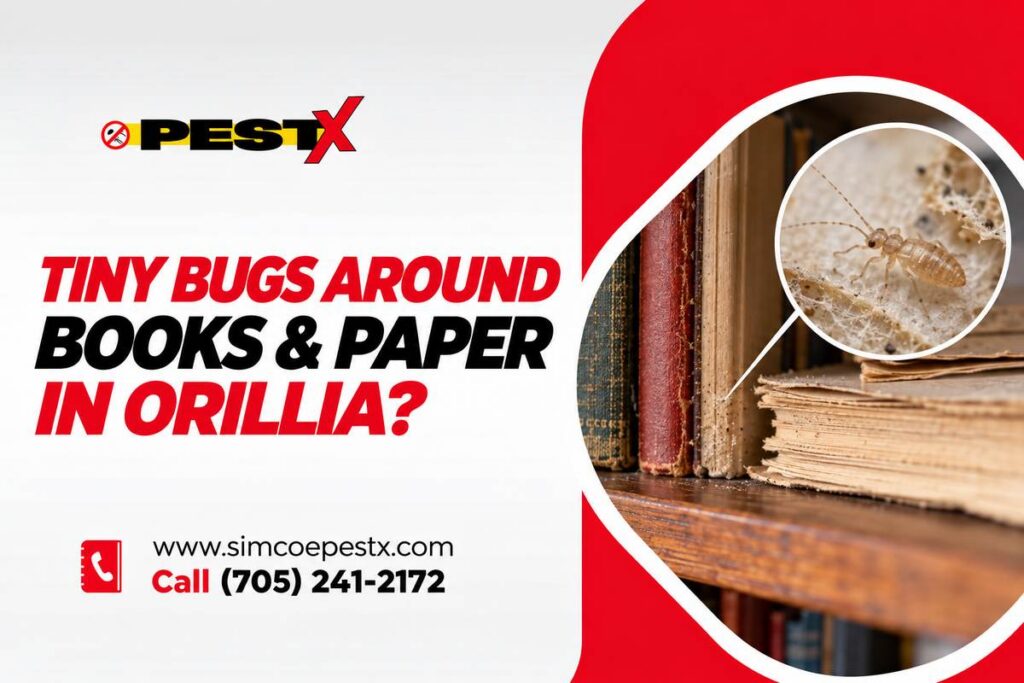
If you are seeing tiny pale bugs around books, paper, cardboard, or shelving, they may be booklice. Booklice are very small insects called psocids. They do not bite people or live on the human body. Instead, they are usually found around materials where microscopic mould, fungi, and other organic matter provide a food source.
How to Tell If the Tiny Bugs You See Are Booklice
The reason why booklice are hard to detect is that they have small sizes, mostly ranging from 1 to 2 millimetres. These insects are usually pale in color; they can appear white, cream, greyish, or nearly translucent. An Orillia pest control expert can help confirm the insect when identification is uncertain.
The body of the booklice is soft, but has a relatively large head than the other parts of the insect. Indoor booklice don’t have wings. Owners may find them creeping very fast along books’ covers or pages, as well as paper and cardboard.
Even though booklice and head lice have similar names, they are two different insects. While human head lice live on human beings and drink blood, the latter do not.
They can also be confused with other tiny indoor pests. A few differences can help:
- Fleas are darker, have powerful back legs, and can jump.
- Mites are often even smaller and may appear as moving dots rather than clearly shaped insects.
- Booklice usually crawl rather than jump and are commonly noticed around paper based or stored materials.
Wherever there are small, pale insects that keep recurring near books, documents, cardboard, or shelving, psocids could be the cause. Examining where the insects are concentrated is yet another way to identify them.
Why Booklice Can Suddenly Become More Noticeable
Booklice do not consume books as their name suggests. The booklice mainly feed on mold, fungi, starches, and organic matter which can grow on or near paper, cardboard, glue, and stored products.
This also goes a long way in explaining why homeowners find it easier to see many booklice at the same time. A few of the insects could have been there for quite some time unnoticed. Their small size and pale color makes them easily undetected until many of them have been observed crawling across a surface.
The discovery of many booklice in a house does not indicate that they are feeding on you, your family members, or your pets. The booklice are not blood-feeding parasites and are not related to head lice.
The appearance of these booklice is mostly an indication of the material and conditions in the specific area. The booklice can mainly be found in one shelf, old papers, cardboard, or books but not all over the house.
For Orillia homeowners that observe growing numbers, it will be important to consider where the insects seem to be coming from. The location can play a role in deciding what materials should be tested and if the activity is occurring in just one spot or multiple spots.
Where to Look If You Think Booklice Are Present
Start by checking the area where you first noticed the insects. Because booklice are so small, looking closely at nearby materials can help reveal whether activity is limited to one item or spread across several surfaces.
Common places to inspect include:
- Books, especially older or rarely moved ones
- Stacks of paper and stored documents
- Cardboard boxes and paper packaging
- Bookshelves and storage shelving
- Wallpaper edges and paper backed materials
- Items stored beside affected books or papers
When examining shelves and single items, use a bright light. Examine along bookspines, edges of pages, cardboard folds, and areas below the storage. It may be easier to spot booklice once they start moving.
Just because some insects are spotted on one cardboard box does not necessarily mean that all books and documents around are infested. Inspect the items around first before determining the extent of the infestation.
It may be helpful to separate potentially infested items temporarily. Clean the shelf and check individual items to see if booklice are clustered around one item.
Take note of how many spots there are with activity. Some insects found in one spot are different from small white insects on several shelves, boxes, and piles of stored papers.
This simple examination process gives residents of Orillia a clearer idea of the situation they are up against before deciding what to do next.
What Orillia Homeowners Should Do If Booklice Keep Showing Up
When booklice have infested book-related products or books, the first step will be to get rid of the disposable products that have been severely affected. For instance, old cardboard boxes, any unwanted papers or broken packaging products can be disposed of as opposed to remaining on site.
Where there are important products such as books, documents, photographs and other important items, it would not be wise to discard them without examining them first. It would be wise to move those that have been affected and clean the shelves or any storage space before replacing anything.
It would help in reducing the insects if one vacuums them from shelves and surrounding areas. After that, one must dispose off the content from the vacuum immediately as to prevent the presence of the insects within the premises.
After cleaning, one should monitor the same place for several days to see if the insects will appear again at the same places. If there are fewer insects in that particular place, then one will know that the activity was limited to the materials one has cleaned.
A qualified pest control technician can confirm whether the insects are booklice and determine how widespread the activity is. If further treatment is needed, a professional pest control provider recommend the appropriate next steps.