
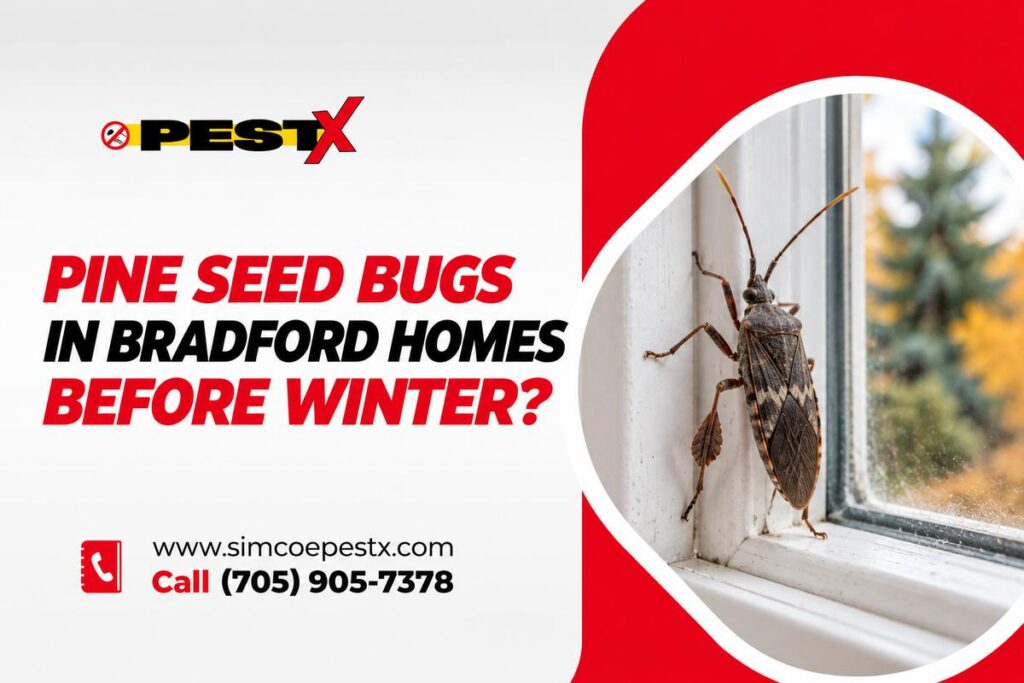
Why Pine Seed Bugs Become More Noticeable in Fall?
The pine seed bug is also known as the western conifer seed bug. These insects usually spend most of their warm season outside near pine, spruce, fir, and other coniferous trees.
They mostly eat immature seeds found in conifer cones. During most of the year, these insects will go unnoticed by the homeowners since all of their activity takes place outside.
This situation changes when the temperature starts to drop in Bradford. A Bradford pest control expert can help confirm the species if homeowners are unsure what type of fall insect they are seeing.
As the autumn becomes colder, these adult seed bugs start searching for sheltered areas where they can stay until winter passes. This seasonal pattern explains why the homeowners start noticing them inside despite not seeing any during spring or summer.
Their appearance can be quite sudden. One day a homeowner may find one big brown insect on the wall, while next week he may see several of them.
It does not necessarily mean that they are breeding in all parts of the house. The pine seed bugs will usually get into homes as adults in search of a safe place where they can spend their winters.
They can also be stimulated to move around on warm autumn or winter days. The indoor warmth or light will trigger a dormant bug to become active, thus explaining why one can be seen on walls or ceilings after it had been unseen for some time.
For people from Bradford, the season may be the most important indicator. If such brown bugs start appearing when the temperatures are dropping outdoors, then this may be the explanation for their behavior.
How to Tell a Pine Seed Bug From a Stink Bug
Both pine seed bugs and stink bugs are brown in color, larger, and might be seen inside when the climate is cold.
Western conifer seed bugs are longer and slimmer compared to stink bugs. Adult western conifer seed bugs are mostly brown with long antennas and hind legs.
The hind legs of pine seed bugs make it easy to distinguish between pine seed bugs and stink bugs. Western conifer seed bugs have flattened segments on their hind legs, making the legs somewhat leaf-like.
A pale marking on the wings is another important distinguishing mark.
Western conifer seed bugs commonly have a white zigzag or whitish marking in the middle of their folded wings.
The body structure of pine seed bugs helps identify them.
Pine seed bugs have an elongated and rectangular body structure.
If you are trying to identify a large brown bug indoors, look for these features:
- A long, narrow brown body
- Long antennae
- Flattened, leaf-like hind legs
- A pale zigzag marking across the wings
- A body that is less shield-shaped than a stink bug
Correct identification matters because similar-looking fall insects do not always behave the same way. Knowing that the insect is a pine seed bug can help a homeowner understand why it appeared and what action, if any, is needed.
Can Pine Seed Bugs Cause Problems Inside a Home?
Although pine seed bugs might be an annoyance inside homes, they are not generally regarded as a destructive household pest.
They do not normally attack furniture, clothing, stored foods, wood, or any other material found in the home. As their natural diet consists of the seeds of the conifer tree, they are simply not looking for anything to eat in your house.
They do not normally sting or bite people.
The real problem with them is their presence. Their larger size and slow motion make them noticeable as they move over walls, curtains, and ceiling.
Pine seed bugs are able to emit a protective odour in case of disturbance or squashing. This is one of the reasons why they are sometimes confused with stink bugs by homeowners.
Squashing one inside the house may cause an unpleasant odour in the area, and so it is better to remove this bug without crushing it.
The presence of several pine seed bugs in the house does not always indicate an infestation.
It is not unusual for adults to find sheltered spots as the temperature drops. Some can stay in hiding for lengthy periods of time and emerge when temperatures inside become warmer.
If there have been some sightings spread out over the fall or winter months, then there is no reason why this should not just be one bug coming out of its hiding place.
What Bradford Homeowners Should Do If They Keep Appearing
When the pine seed bug is indoors as a single specimen, manual removal becomes the easiest method to employ.
The insect can be picked up by a container and released back into the environment outside if conditions permit. The vacuum cleaner can also be employed for getting rid of the insect in the walls, floor, and any place that can be reached.
It is advisable to not crush the insect whenever possible since the disturbance of the insect may cause it to emit odor.
One should not automatically conclude that all large brown insects seen indoors during autumn are pine seed bugs. Other types of insects such as stink bugs may appear similar at a glance.
One needs to examine its body structure, hind legs, and wing markings.
Professional advice may be useful when:
- Pine seed bugs are appearing in larger numbers
- New bugs continue showing up over an extended period
- You are unsure whether the insects are pine seed bugs or another species
- Indoor activity becomes difficult to manage through simple removal
A pest control provider can confirm the species and determine whether additional action is necessary.