
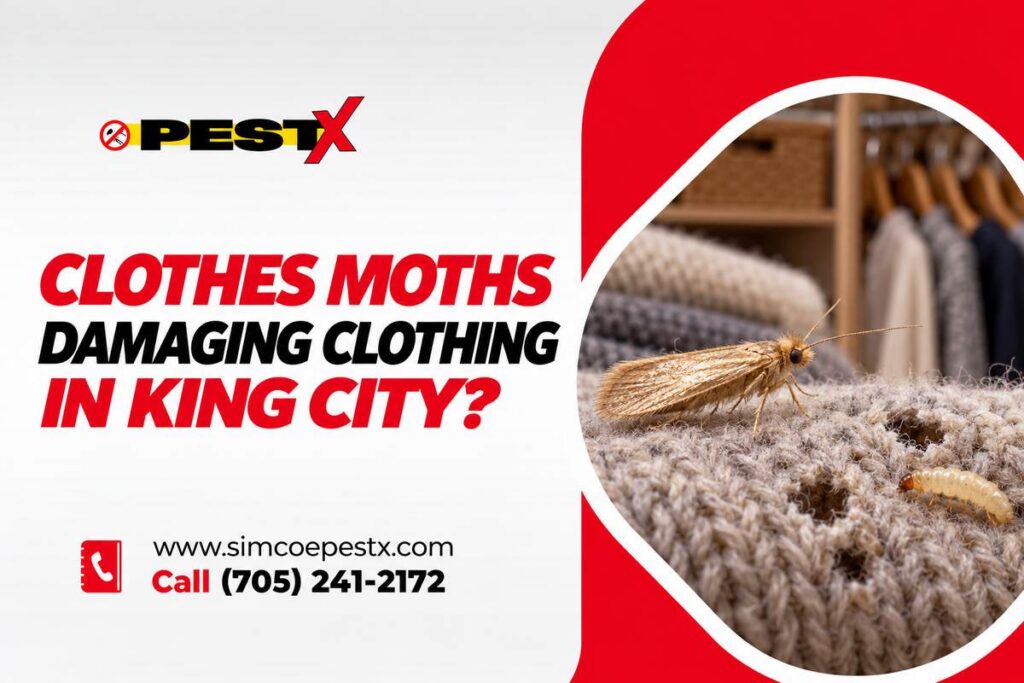
If you notice inexplicable holes in woollen clothes, blankets, rugs, and other items made of natural fibres, it is quite possible that clothes moth larvae are to blame. Clothes moths themselves do not feed on fabrics. The damage is done by the larvae, which feed on fibres containing animal products like wool, fur, feathers, and felt.
As the larvae prefer to hide in quiet corners, the damage can occur without the presence of any moths being noticed by the homeowner. A King City pest control expert can help identify the source when signs of insect activity continue.
Why Clothes Moth Damage Often Goes Unnoticed
It may be hard to recognize clothes moth infestation due to the fact that the destructive stage is invisible to the eye. Clothes moth larvae, but not adult moths, eat fabrics.
Adult moths mostly participate in reproductive processes. After eggs hatch, small larvae start eating suitable material. They can hide in folds, under clothes, along the edges of rugs, and in any other place that is not constantly disturbed.
This way, a homeowner does not have to see any moths flying around a room before noticing any damage.
Clothes moth larvae are able to hide in the places where the clothing is not touched for a long time. For instance, a woollen sweater, left at the bottom of a wardrobe for a long period, can be overlooked for several months. During this time, larvae can stay near the fabric and keep eating.
The first warning sign may be:
- Small or irregular holes in clothing
- Areas where fabric appears thinner
- Fine silk-like webbing
- Shed larval skins
- Damage concentrated around seams or folds
The position where the damage occurred could also give hints. The larvae of clothes moths tend to favor darkened and disturbed places than open places that are frequently used.
Just because one little moth is observed does not necessarily imply that there is clothing damage going on. It is when fabric damage occurs along with larvae, webs, or cast skin that more evidence will be seen.
How to Check Clothing and Fabrics for Signs of Moths
Start by examining the damaged item under good lighting. Clothes moth damage can sometimes resemble ordinary wear, so it helps to look for more than holes alone.
Check seams, cuffs, collars, folds, pockets, and areas where fabric rests against other materials. These locations give larvae more cover and may show signs before exposed parts of the garment do.
Look for several indicators:
- Irregular holes: Damage may appear as scattered holes rather than the predictable thinning caused by normal wear.
- Small larvae: Clothes moth larvae are pale and caterpillar-like, although they can be difficult to notice.
- Silk-like material: Some species leave fine webbing around feeding areas.
- Shed skins: Empty larval skins may remain on or near affected fabrics.
- Small cases: Certain clothes moth larvae create portable cases made partly from fibres.
Homeowners should check items in the vicinity rather than checking just the item with the damage. When a wool coat has been damaged, one should check sweaters, scarves, blankets, or any other natural fibre fabric around it.
One should take special note of wool and other animal fibres. This type of damage is indicative of clothes moth damage, not damage limited to synthetic clothing.
Normal wear usually occurs in predictable places, such as on elbows, knees, cuffs, or places that have seen a lot of friction. Moth damage can occur in unexpected places, such as in folds or untouched areas.
The presence of larvae or materials associated with them around the damaged fabric is the best evidence of moth damage.
Which Household Items Are Most Vulnerable?
Clothes moth larvae do not feed equally on every type of fabric. They are most strongly associated with materials that contain animal-based fibres, especially those rich in keratin.
Commonly affected materials include:
- Wool
- Cashmere
- Fur
- Felt
- Feathers
- Silk blends containing animal fibres
Synthetic fibres like polyester and nylon tend to look unattractive as well. However, if synthetic fibres have wool blended in, they can become vulnerable too.
In a typical King City house, it is the seasonal clothing that needs to be checked initially. These clothes will not be used for quite some time.
Carpets and upholstered furniture can be infested too. Areas such as corners of carpets and underneath chairs should be carefully examined.
Since infestation can take place inside stored materials, they need more careful inspection. In case of clothes moth problem in the house, valuable clothes made from wool, handmade carpets, and natural fibre blankets should be checked with care.
Differences in extent of damage in different materials can vary widely. For instance, one sweater may have several holes in it while a similar garment next to it can have no damages at all.
What to Do If You Discover Clothes Moth Activity
If there are any larvae, webbing, skins, or other signs that indicate clothes moths, the first step would be to separate those clothes or textiles from all other items in your wardrobe.
Check other natural fibre goods nearby to determine how widespread the problem is – whether it’s just one item or more in the same vicinity.
Different fabrics will require different cleaning procedures. All washable clothing should be washed according to their labels. Some materials should be sent for professional dry cleaning. Other rugs and upholstery can be cleaned according to the manufacturer’s recommendations.
Vacuuming may also be useful for removing loose larvae and other stuff from appropriate surfaces. Areas to clean include the edges of rugs, seams of upholstered furniture, closet shelves, and places where damaged textile was stored.
Do not immediately discard clothing or fabrics that may still have some useful life left in them after being appropriately cleaned, particularly where the damage is restricted.
Keep monitoring the cleaned items during this period. Where there are signs of new holes, the presence of larvae, or damage is evident in multiple rooms or textile items, the activity needs further evaluation.
Clothes Moth Control in King City may be required where the owner continues to find larvae or signs of damage after cleaning the affected items. An expert in pest control from Simcoe PestX will evaluate the source of the activity and advice on the necessary course of action.