
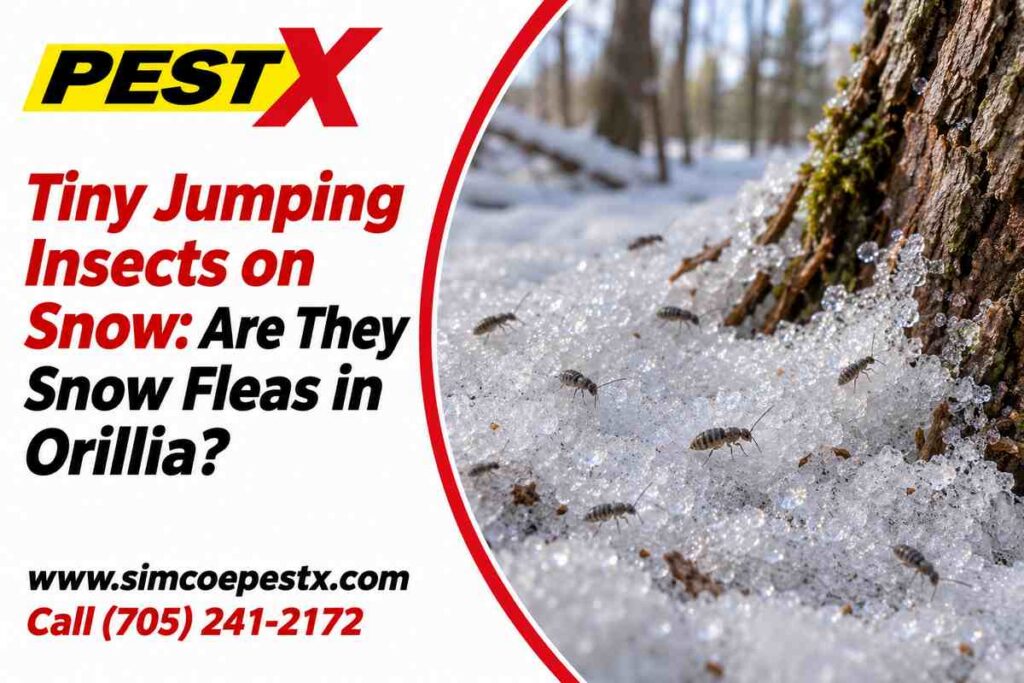
What Are the Tiny Black Insects Jumping on Snow?
If you see black spots that move around on a snowy area, then these might be snow fleas. Snow fleas are among the springtails that are mostly found in the soil, fallen leaves, and decomposing plants. An Orillia pest control expert can help with identification if you are unsure what the tiny jumping creatures are.
Springtails are six-legged arthropods from the family Collembola. Though similar to insects, they are not considered true insects in the modern classification of animals.
Snow fleas are especially noticeable during winter because of the stark contrast between their dark color and the white snow.
Common identification features include:
- Size: Usually around 1–2 millimetres long, making them difficult to examine without magnification.
- Colour: Dark blue, grey, or nearly black.
- Body shape: Small, wingless bodies with short antennae and six legs.
- Movement: Sudden jumps or flicking movements rather than steady crawling.
- Location: Often found on snowbanks, near trees, around garden beds, and along wooded areas.
Their most unique characteristic is a special jumping mechanism known as a furcula.
The forked appendage is usually tucked underneath the abdomen of the organism. When released, it hits the surface and pushes the springtail upward in the air.
They can be quite fast-moving even though they are tiny organisms. Snow fleas may seem to vanish and then reappear a little way off.
Orillia homeowners may come across many of these tiny organisms gathered around melting snow. The whole lot will look like pepper grains from a distance.
Not all tiny black insects found on snow are snow fleas. Other arthropods can sometimes be seen in mild winter weather conditions as well.
To help with identification, one can take a closer look at the movements of the organisms.
Are Snow Fleas the Same as Fleas That Bite People and Pets?
No. Snow fleas are springtails, not the parasitic fleas that bite people and animals.
The name comes from their ability to jump and their tendency to appear on snow. It does not mean they are related to the fleas commonly found on dogs or cats.
There are several important differences:
- Snow fleas feed mainly on decaying organic matter, fungi, and other materials found in their natural habitats.
- True fleas are parasites that feed on the blood of mammals or birds.
- Snow fleas do not feed on blood and are not known to bite people or pets.
- Finding snow fleas outdoors does not indicate a household flea infestation.
Snow fleas also do not have the specialized mouth parts that true fleas have to be able to puncture skin and feed on blood.
If you happen to notice small jumping insects in your yard in Orillia during winter, there is nothing to fear for yourself or your pets.
They are just a normal part of nature.
Why Do Snow Fleas Appear on Snow During Winter?
Snow fleas live on snow because particular kinds of springtails can develop the ability to be active in cold environments.
While most small arthropods tend to become inactive in Ontario winters, some types of snow springtails can withstand the temperatures dangerous for other insects.
A special ability of such snow fleas is that they possess the specialized proteins that act as the antifreeze.
Scientists discovered that there exist some particular species of springtails with the ability to produce proteins that do not let ice grow in their bodies.
Unfortunately, these proteins and abilities have limitations, so all springtails are not adapted to withstand all sorts of cold weather.
For example, snow cover plays its significant role for the survival of snow fleas during winter.
The snow insulates the soil, thus providing it with the relatively warm environment comparing with the atmosphere.
Moreover, snow fleas can stay in the soil where they are safer than outside.
These insects will come to the surface when conditions are suitable.
In Simcoe county and around Orillia, residents will be able to observe these insects moving on snow in winters when snow melts.
Moisture and organic material also influence where springtails live.
They are commonly associated with:
- Damp soil beneath snow-covered gardens.
- Fallen leaves and decomposing vegetation.
- Moist areas around trees and shrubs.
- Wooded properties with layers of leaf litter.
- Garden beds containing organic mulch.
These environments provide shelter and food throughout the year.
Snow fleas are often present long before homeowners notice them. Their dark colouring simply makes them easier to see against white snow.
Seeing springtails outdoors during winter does not mean they are trying to enter your home.
Why Do Snow Fleas Gather in Large Groups on Warm Winter Days?
The snow fleas can congregate in clusters where the temperature and moisture levels are favorable.
When it is cold, they tend to stay hidden under the snow or in the soil and leaf litter. When conditions are favorable, they come out.
For instance, a homeowner living close to a forested region in Orillia could see hundreds of dark spots on snowbanks on an afternoon that is not very cold.
Several factors can make these gatherings more noticeable:
- Milder temperatures: Less severe cold can allow winter-active springtails to move across exposed snow.
- Suitable moisture: Damp conditions help support their activity.
- Nearby organic matter: Soil, leaf litter, and decaying vegetation provide suitable habitats.
- Visible contrast: Dark springtails are easier to notice on white snow than against dark soil.
This does not mean that there has been an abrupt rise in the number of springtails in the locality. They could have been there for months but went unnoticed.
Every warm day during winter will not result in their activity. It will depend on the type of species, temperature, moisture, and environment.
For homeowners in Orillia and Simcoe County, finding small clusters of them hopping around on the snow during winter is quite common.
Are Snow Fleas Harmful, and Should Orillia Homeowners Remove Them?
Snow fleas are not harmful to humans, animals, and property. Finding them outside in winter does not mean that there is a pest infestation or that treatment is needed.
Although snow fleas have a jumping capability, they do not bite or suck blood from humans or animals. Snow fleas do not transmit any disease-causing organisms to people or animals.
Snow fleas do not cause any harm to buildings, woodwork, lawn, and garden plants.
Instead, springtails have a beneficial function in the environment. Some species of springtails feed on fungi, decaying leaves, and other organic materials. Thus, their feeding activities help to break down organic materials in the soil ecosystem.
Orillia homeowners who find many snow fleas in the snow bank of their garden may find the sight alarming. Nevertheless, their presence in large numbers does not mean that they are causing any damage.
Outdoor snow fleas should not be disturbed. It is unnecessary to spray insecticides on snow, lawn, and garden because it will only pollute the environment but provide no real benefits.
Homeowners should check whether the tiny jumping insects are simply gathered in the outdoor areas or inside the house.
Springtails occasionally enter homes through gaps around doors, windows, and foundations. They may also be associated with damp conditions inside the building.
Indoor springtails are commonly found in:
- Basements: Areas with excessive humidity, condensation, or water seepage.
- Bathrooms: Damp spaces around sinks, drains, and plumbing.
- Laundry rooms: Areas with leaking pipes or wet flooring.
- Houseplants: Moist potting soil containing organic matter.
- Foundation areas: Locations where water collects near exterior walls.
Finding one or two springtails indoors does not necessarily indicate an established problem.
When Do Springtails Around Your Home Require Pest Control?
Springtails found on outdoor snow rarely require professional pest control. Their presence is usually a natural part of winter activity.
However, further investigation may be useful when:
- Tiny jumping creatures repeatedly appear inside your home.
- Springtails continue returning despite efforts to reduce moisture.
- You notice damp walls, persistent condensation, or unexplained water damage.
- You cannot confidently identify the jumping creatures.
- Large numbers regularly appear in indoor areas where moisture problems are suspected.
The initial step would be to establish the kind of pests and the environment where they thrive.
When springtails are concerned, addressing moisture issues takes priority over using pesticides.
In case you are in Orillia and the neighboring Simcoe County, Simcoe PestX will assist in identifying any potential pests inside your home.
Please note that snow fleas moving on top of the snow in the outdoors are non-harmful pests. They don’t require extermination just because of their presence.
