
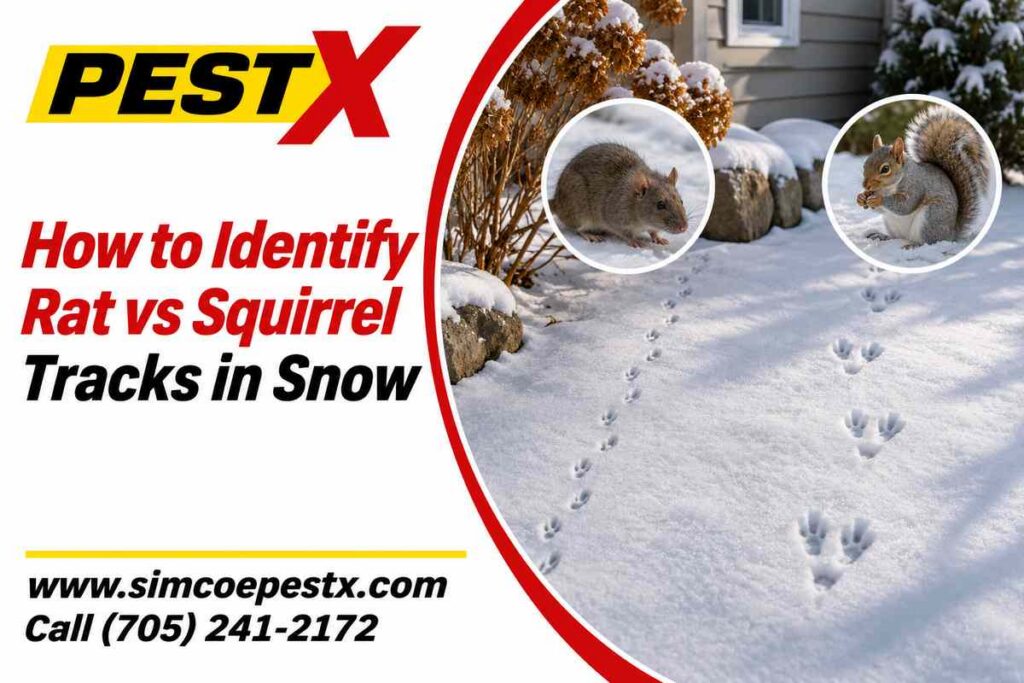
Rat and squirrel tracks in snow can look similar, but their footprints and movement patterns provide useful clues. Rat tracks are generally smaller and may include a thin tail-drag mark. Squirrel tracks commonly appear in groups of four, with larger hind footprints landing ahead of smaller front prints.
To tell them apart, examine the footprint shape, toe impressions, size, track spacing and direction of travel. A single footprint or tail mark is rarely enough for reliable identification.
For homeowners in Barrie and Simcoe County, fresh snowfall offers a chance to spot animal activity around garages, sheds, decks and yards. However, melting snow, deep powder and overlapping tracks can make identification difficult. A Barrie pest control expert can help when recurring tracks appear alongside signs of building entry or damage.
What Is the Difference Between Rat and Squirrel Footprints in Snow?
The main difference between rat and squirrel footprints is their size and proportions. Rat footprints are usually smaller and more compact, while squirrel hind footprints tend to be longer and more noticeable than their front prints.
Both animals have four toes on their front feet and five on their hind feet. However, the shape and arrangement of their footprints can help distinguish them.
What Do Rat Footprints Look Like in Snow?
Rat footprints often resemble tiny hands, with narrow toes extending from a central paw pad. Their front feet are generally smaller than their hind feet.
In clear, shallow snow, you may notice:
- Four toe impressions on the front feet and five on the hind feet.
- Small paw pads beneath the toes.
- Thin claw marks extending beyond some toe impressions.
- Slightly longer hind footprints compared with the front footprints.
A rat’s toes can spread against the snow, creating a hand-like appearance. However, not every toe or claw will leave a clear mark.
According to Cornell Integrated Pest Management, rat footprints typically measure approximately 1.9–3.2 cm in length, depending on whether the impression comes from a front or hind foot.
What Do Squirrel Footprints Look Like in Snow?
Squirrel footprints also have long, narrow toes, but the difference between their front and hind feet is often more noticeable.
Their hind feet are longer and may appear slightly turned outward in a clear track. The front footprints are smaller and commonly appear close together.
In suitable snow, squirrel tracks may show:
- Four toes on each front footprint and five on each hind footprint.
- Long, slender toe impressions.
- Larger, elongated hind footprints.
- Small claw marks and visible paw pads.
- Two larger hind footprints positioned ahead of two smaller front prints.
Both red squirrels and grey squirrels are found in Ontario. Their footprints have similar shapes, although grey squirrel tracks are generally larger.
The Canadian Wildlife Federation lists red squirrel front footprints at approximately 2.0–3.8 cm long and hind footprints at 3.8–5.8 cm long.
Rat vs Squirrel Tracks in Snow: Comparison Table
| Feature | Rat Tracks | Squirrel Tracks |
|---|---|---|
| Footprint shape | Small, hand-like impressions | Elongated toes, especially on hind feet |
| Front and hind feet | Hind prints generally larger | Hind prints noticeably longer than front prints |
| Toe impressions | Four front toes, five hind toes | Four front toes, five hind toes |
| Typical size | About 1.9–3.2 cm long | Red squirrel: front 2.0–3.8 cm; hind 3.8–5.8 cm |
| Claw marks | May appear as fine points | May appear beyond long toes |
| Identification limits | Can resemble smaller rodents | Size varies by squirrel species and snow conditions |
Measurements are approximate reference ranges, not exact identification rules. The rat figures come from Cornell Integrated Pest Management, and the red squirrel figures come from the Canadian Wildlife Federation.
Can You Identify a Rat or Squirrel by Footprint Size Alone?
No. Footprint size alone cannot reliably distinguish rats from squirrels. Their measurements can overlap, especially when comparing larger rats with smaller squirrels.
A red squirrel’s front footprint may be similar in length to a rat’s hind footprint. Grey squirrel tracks are generally larger, but size still needs supporting evidence.
Snow conditions also affect measurements.
Deep powder may collapse around a footprint, making it appear wider. Melting can enlarge impressions, while refreezing may blur the toes and paw pads.
For example, a homeowner in Barrie might discover several small prints beside a garage after overnight snowfall. If the snow has partly melted, the impressions may appear much larger than the animal’s actual feet.
For a more accurate comparison, examine several clear footprints. Look at their length, width and proportions rather than measuring one impression.
Mouse and vole tracks can also cause confusion. These smaller rodents may leave tiny footprints or paired marks in snow. Their trails sometimes include tail impressions.
If the footprints remain unclear, examine how the animal moved. Track patterns often provide better clues than individual measurements.
How Do Rat and Squirrel Track Patterns Differ in Snow?
Squirrels commonly leave four-print hopping patterns, while rats may produce staggered walking tracks or grouped prints when moving quickly. The arrangement of the footprints helps show how each animal travelled.
Understanding movement is particularly useful when individual prints lack clear toe or claw details.
Why Do Squirrel Tracks Appear in Groups of Four?
Squirrels move across snow using a hopping or bounding motion.
As a squirrel moves forward, its front feet touch the snow first. Its larger hind feet then move past them and land farther ahead.
This creates a repeated pattern of four footprints:
- Two smaller front footprints positioned behind.
- Two larger hind footprints positioned ahead.
- A gap before the next group of four.
- Front footprints that are often close together or side by side.
The larger hind prints may turn slightly outward, creating a roughly rectangular group.
Ontario Parks identifies this arrangement as a characteristic squirrel pattern. Credit Valley Conservation also notes that trails connecting trees, with four grouped footprints and larger prints in front, commonly indicate squirrels.
Squirrel tracks may cross a snow-covered yard before ending at a tree or fence. A trail connecting climbing structures is another helpful clue.
However, not every squirrel trail forms four perfect impressions. Deep snow may cause the front and hind footprints to overlap, leaving only two visible marks.
How Do Rats Move Through Snow?
Rats can walk, run and make short bounds. Their footprints change depending on their speed and the ground beneath them.
When walking, rats may leave a staggered sequence of footprints, with front and hind impressions appearing close together.
During faster movement, their footprints may form repeated groups, sometimes resembling the tracks of other small rodents.
Rat trails may show:
- Small footprints arranged in a staggered or grouped sequence.
- Front and hind prints positioned close together.
- Shorter or longer gaps depending on movement speed.
- A narrow tail mark between some footprints.
- Trails following sheltered edges, walls or fences.
Norway rats commonly leave nearby front and hind impressions while walking, although faster movement changes their track arrangement.
Around a Barrie home, suspected rat tracks may follow the edge of a garage, shed or foundation rather than crossing an exposed yard.
These protected routes can provide shelter from wind and direct exposure.
However, a trail beside a building does not automatically mean rats are present. Mice, voles and other small mammals may use similar routes.
Does Track Spacing Help Identify the Animal?
Yes. The distance between footprints and repeated track groups can reveal how an animal travelled.
Squirrels often leave noticeable gaps between their four-print groups when bounding. The distance changes with speed, body size and snow depth.
Rats may leave more closely spaced impressions while walking, although their tracks can spread farther apart when running or bounding.
Direction is another clue. Look at how toes point and where the trail leads.
For example, a repeated four-print pattern moving between two trees may suggest a squirrel. Small, staggered prints following a sheltered foundation could suggest a rat or another small rodent.
These patterns are helpful but cannot confirm a species without additional evidence.
Does a Tail Drag Mark Mean the Tracks Belong to a Rat?
No. A tail-drag mark can support rat identification, but it does not prove that a rat made the tracks.
Rats have long tails that may touch the snow as they move. When this happens, the tail can produce a narrow groove between the footprints.
The line may appear straight, curved or slightly winding depending on how the animal travelled.
However, rats do not always leave tail marks. A raised tail, harder snow surface or changes in movement may prevent a visible impression.
Squirrels can also leave tail or foot-drag marks, especially in deeper snow. The Canadian Wildlife Federation notes that red squirrel trails may contain these impressions.
Mice and some other small rodents may leave similar marks.
The most useful clues are the footprints around the drag mark. Check their size, arrangement and spacing before deciding which animal made the trail.
Snow conditions can complicate this process. Fresh powder may hide shallow impressions, while melting can merge footprints and tail marks into one groove.
If the trail remains unclear, avoid making a firm identification from a single feature.
What Should You Do if You Find Rat or Squirrel Tracks Around Your Barrie Home?
If you discover rat or squirrel tracks in snow around your Barrie home, start by documenting the trail and checking where it leads. Outdoor footprints do not automatically mean an animal has entered your house.
The following steps can help you identify the activity and decide whether further investigation is necessary.
Step 1: Examine the Complete Trail
Follow the visible tracks from a safe distance rather than focusing on one footprint.
Look for where the trail begins and ends. For example, tracks connecting two trees may indicate normal squirrel activity. Small footprints repeatedly following a garage wall could suggest a rodent or another small mammal.
Pay attention to trails near:
- Garage doors and exterior walls.
- Sheds and outdoor storage areas.
- Decks, porches and foundations.
- Fences, trees and climbing structures.
- Accessible roof edges and exterior vents.
Record whether the trail crosses an open area or stays close to sheltered surfaces.
Step 2: Photograph and Measure the Footprints
Photographs help preserve evidence before fresh snowfall or foot traffic changes the tracks.
Take several clear pictures of the footprints and surrounding trail. Place a ruler beside an impression to show its approximate size.
For better results:
- Photograph individual prints from directly above.
- Measure the length and width of several clear impressions.
- Take a wider photograph showing the full trail.
- Record the date, location and recent snow conditions.
- Avoid stepping on or disturbing the tracks.
These details can help distinguish animal activity when the footprints are difficult to identify.
Step 3: Look for Additional Evidence Around Your Property
Footprints become more useful when combined with other signs of animal activity.
Check accessible outdoor areas for gnaw marks, damaged materials, droppings or possible entry points.
For suspected rat activity, look for fresh digging near foundations, damaged storage containers and signs of movement along sheltered walls.
Ontario’s guidance on rodent identification lists burrows, gnawing damage, droppings and frequently used pathways as common evidence of rodent activity.
For possible squirrel activity, inspect accessible areas around fences, trees and exterior structures. Damaged soffits or loose roof vents may also deserve attention.
However, neither gnaw marks nor outdoor footprints confirm that an animal is living inside your home.
Step 4: Monitor Tracks After Fresh Snowfall
Fresh snow can help reveal whether an animal repeatedly uses the same route.
After another snowfall, examine the area where you originally discovered the footprints.
Check whether new tracks:
- Follow the same path towards your garage or shed.
- Reappear near a foundation or exterior opening.
- Connect climbing structures to accessible roof areas.
- Continue towards outdoor food storage or waste containers.
For example, a homeowner in Simcoe County might notice fresh tracks leading beneath a shed after several snowfalls. This suggests repeated activity worth monitoring, but does not identify the species or confirm an infestation.
Step 5: Avoid Unsafe Investigations
Do not climb onto icy roofs, enter unsafe crawl spaces or disturb animals inside enclosed areas.
If you notice a possible entrance, avoid sealing it until you know whether animals are using it. Blocking an occupied opening could trap wildlife inside.
Ontario’s wildlife guidance recommends checking for animals before closing entry points.
When Do Animal Tracks Near Your House Require Pest Control?
Animal tracks near your house may justify a professional inspection when they appear repeatedly alongside evidence of building entry or damage.
A few squirrel footprints crossing a snow-covered yard are usually normal outdoor activity. Similarly, small tracks near a foundation do not automatically indicate a rat infestation.
Consider contacting a pest control or wildlife professional when you notice:
- Recurring tracks: Fresh trails repeatedly lead towards the same suspected building opening.
- Property damage: Gnaw marks, damaged vents, chewed materials or disturbed insulation.
- Possible entry points: Visible gaps around garages, foundations, roof edges or soffits with supporting signs of activity.
- Indoor evidence: Droppings, scratching noises, damaged stored food or other unexplained animal activity inside the building.
Professional identification is particularly useful when the footprints could belong to rats, mice or other small mammals.
If evidence points towards rats, a rodent inspection can help locate activity and potential access points. Suspected squirrels entering roof spaces or attics may require an appropriate wildlife inspection and humane removal approach.
Simcoe PestX provides local pest control and wildlife removal services in Barrie and Simcoe County. Homeowners who find recurring tracks alongside suspected entry points or property damage can request an inspection to identify the concern and determine suitable next steps.
