
How to Safely Check Wasp Hotspots Around Backyard Decks and Eaves
Wasps often choose sheltered locations that provide protection from weather and disturbance. Around Bradford homes, potential nesting areas can include deck framing, roof eaves, soffits, sheds, backyard structures, wall openings, and ground-level cavities.
If wasps repeatedly return to the same location, the safest approach is usually to observe their movement from a distance rather than trying to get close enough to find the nest.
Knowing where to look—and what not to disturb—can help homeowners identify possible wasp activity without unnecessarily increasing the risk of stings.
1. Under Deck Framing and Joists
Raised wooden decks create numerous shaded and protected areas that may provide suitable nesting locations.
Check visually around:
- Undersides of deck boards
- Joists and beams
- Deck stairs
- Railings
- Support structures
- Protected corners
A nest beneath a deck may not be immediately obvious. Instead, homeowners may first notice an increasing number of wasps repeatedly flying beneath the deck or disappearing behind structural components.
This can become particularly concerning when activity occurs close to:
- Barbecues
- Patio tables
- Exterior doors
- Children’s play areas
- Frequently used seating areas
Rather than crawling beneath the deck or reaching into hidden areas, watch the insects from a safe distance and look for a repeated flight path.
2. Roof Eaves, Soffits and Overhangs
Eaves and roof overhangs can provide protected locations for exposed wasp nests. Openings around soffits, siding, or roofline components may also allow wasps to enter concealed spaces.
Watch for insects repeatedly travelling toward:
- Soffit gaps
- Roof eaves
- Siding openings
- Vent areas
- Roofline gaps
If several wasps repeatedly enter and leave the same small opening, there may be a concealed nesting area beyond the visible entrance.
Avoid Ladder Inspections Around Active Wasps
A nest that appears small from the ground may still be difficult to inspect safely.
Climbing a ladder near active wasps creates an additional hazard because sudden insect activity can cause a person to lose balance or make an unexpected movement.
If reaching the suspected nest requires a ladder, roof access, or leaning over an elevated structure, professional assessment is generally the safer option. Health Canada notes that active wasp-nest removal can be dangerous and recommends professional help where appropriate.
3. Playsets, Sheds and Backyard Structures
Wasps may also use protected locations around outdoor structures.
Possible areas include:
- Wooden playsets
- Swing frames
- Playhouses
- Garden sheds
- Gazebos
- Fence structures
- Outdoor storage boxes
Before children use a play structure where wasps have recently been noticed, visually check the surrounding area from a distance.
Pay attention to repeated insect movement beneath platforms, around railings, under roof sections, or into protected openings.
Do not place your hands inside hidden spaces or move objects simply to determine whether a nest is present.
If regular wasp traffic is occurring around a frequently used backyard structure, restrict access to the immediate area until the source has been identified.
4. Ground Cavities and Landscaping
Not every wasp nest is above ground. Some yellowjackets can establish colonies in protected ground-level cavities.
Bradford homeowners should watch for repeated wasp movement around:
- Small openings in soil
- Old animal burrows
- Tree roots
- Garden edges
- Retaining walls
- Decorative stonework
- Other protected ground-level openings
One useful warning sign is a steady pattern of wasps entering and leaving the same small opening.
Avoid mowing, digging, trimming, or walking directly around a suspected ground nest until the activity has been assessed.
How to Safely Check for Wasp Activity Without Disturbing the Nest
If you suspect wasps are nesting around your Bradford property, focus on observation rather than direct inspection.
In many situations, flight patterns provide enough information to identify the likely nesting area without approaching it closely.
Watch the Flight Pattern
Stand well back from the suspected area and watch where the insects repeatedly travel.
Look for consistent movement around:
- Deck beams and stairs
- Soffit or siding gaps
- Roof eaves
- Shed corners
- Retaining walls
- Ground openings
One or two wasps visiting flowers, garbage, or outdoor food does not necessarily indicate a nest on the property.
Repeated traffic into one specific opening is more significant than occasional wasp activity around the yard.
Observe From a Safe Distance
There is no need to stand directly beside an entrance to determine whether insects are using it regularly.
Choose a location where you can watch activity without blocking the wasps’ flight path or placing yourself close to the suspected nest.
Even when activity appears reduced, an active colony should still be treated cautiously.
Do Not Touch, Shake or Block the Nest Area
Trying to confirm a nest by disturbing the surrounding structure can trigger defensive activity.
Avoid:
- Poking a visible nest
- Knocking on siding or soffits
- Pulling apart deck materials
- Moving objects covering an entrance
- Plugging an active opening
- Cutting vegetation directly around an active ground entrance
Blocking an opening without understanding the nest location can also interfere with the insects’ established route and may not address the colony itself.
Safe homeowner inspection should generally be limited to visual observation.
Keep Children and Pets Away From Active Areas
If wasps repeatedly return to one location, temporarily keep children and pets away from that portion of the yard.
Also avoid unnecessary:
- Mowing
- Pruning
- Deck maintenance
- Gardening
- Digging
- Outdoor play near the suspected nest
This is particularly important when activity occurs near a deck, doorway, patio, playset, or another area that people use frequently.
Professional Wasp Control in Bradford
When a nest is concealed, elevated, underground, or located close to a frequently used area, professional pest control in Bradford can help identify the nesting location and determine an appropriate control approach.
A professional inspection can be especially useful when wasps repeatedly disappear into a soffit, wall opening, deck structure, or ground cavity and the nest itself cannot be seen.
Paper Wasps vs. Yellowjackets
Not every wasp around a Bradford backyard behaves or nests in exactly the same way.
Two groups homeowners may encounter are paper wasps and yellowjackets. Social wasps can construct both exposed and concealed paper nests depending on the species.
Paper Wasps
Paper wasps commonly construct exposed paper nests with visible open cells.
Potential nesting areas include:
- Roof eaves
- Deck framing
- Porch ceilings
- Shed overhangs
- Railings
- Gazebos
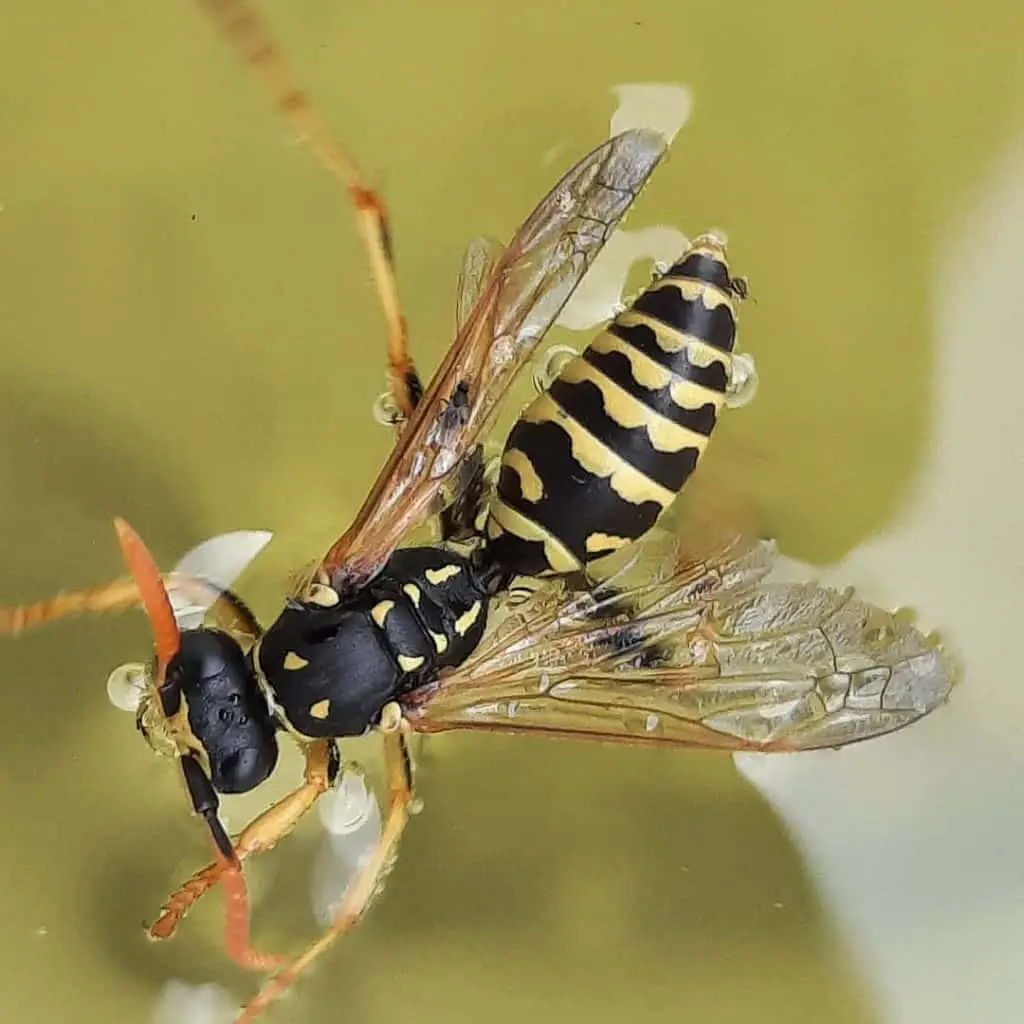
Paper wasps typically have relatively slender bodies, and their legs may be noticeable while they are flying.
Even when activity appears limited, homeowners should avoid knocking down, handling, or disturbing an occupied nest.
Yellowjackets
Yellowjackets are social wasps that may establish colonies in concealed structural areas or protected ground cavities.
Possible nesting areas include:
- Old ground burrows
- Wall cavities
- Soffits
- Landscaping gaps
- Retaining walls
- Protected structural openings
Yellowjackets may also become noticeable around garbage, outdoor meals, sweet drinks, and other food sources. Health Canada notes that some social wasps commonly scavenge around garbage and that many pest wasps can sting when disturbed.
Why Correct Wasp Identification Matters
The type of insect and location of the nest can affect how the problem should be managed.
An exposed paper nest beneath an eave is different from wasps repeatedly entering:
- A wall cavity
- A soffit opening
- An underground burrow
- A concealed deck space
Homeowners should also avoid assuming that every yellow-and-black insect seen outdoors requires treatment.
Many wasps provide ecological benefits by feeding on other insects. The greater concern is repeated activity associated with an active nesting site near people, pets, entrances, patios, or play areas.
Why DIY Wasp Nest Removal Can Be Risky
Spraying, knocking down, or otherwise disturbing an active nest may trigger defensive behaviour from the colony.
The risk can increase when the nest is:
- Hidden
- Elevated
- Underground
- Inside a structural cavity
- Close to a frequently used area
Professional wasp nest removal may be appropriate when homeowners cannot clearly locate or safely access the nesting area.
The Nest May Be Larger or Farther Away Than the Visible Opening
A small exterior opening does not necessarily indicate the exact position of a concealed nest.
Wasps entering through a soffit, siding gap, wall opening, or other structural space may travel farther inside before reaching the colony.
Treating or blocking only the visible entrance may therefore fail to address the actual nesting area.
This is one reason professional inspection can be useful when wasps repeatedly disappear into a building rather than travelling to an exposed nest.
Ladders and Active Wasp Nests Are a Risky Combination
Nests around second-storey eaves, soffits, rooflines, and other elevated areas may require working at height.
Trying to spray or remove an active nest while standing on a ladder can create two hazards at once: defensive wasp activity and the risk of falling.
If accessing a nest requires climbing or reaching from a ladder, homeowners should consider professional service rather than attempting removal themselves.
Ground Nests Can Be Disturbed Accidentally
Underground nests are not always easy to see.
Homeowners may discover activity only after mowing, trimming, digging, or walking through the area.
If multiple wasps repeatedly enter the same ground opening, stop yard work in the immediate area and keep people and pets away until the situation has been assessed.
Store-Bought Wasp Products Must Be Used Carefully
If a homeowner chooses to use a pesticide, the product should be registered for the intended use in Canada and the label should specifically include the target pest and application method.
Health Canada advises consumers to look for a Pest Control Product registration number and to follow all label directions and warnings.
Applying excessive product, spraying from an unsafe position, or treating an opening without understanding where the nest is located can increase risk without necessarily resolving the underlying problem.
When to Call an Exterminator for Wasps
Professional assistance may be appropriate when:
- The nest is high above ground.
- The nest is inside a soffit or wall cavity.
- Wasps are repeatedly entering a ground opening.
- The nest is close to a doorway or patio.
- Children or pets regularly use the affected area.
- The nesting location cannot be identified.
- Large numbers of wasps are present.
- Safe access would require a ladder.
Health Canada recommends professional help for active nest removal because disturbing a colony can result in an attack by multiple wasps.
When active wasp nesting is concealed or difficult to access, an experienced exterminator can inspect the area and recommend appropriate pest-management measures.
Check Bradford Wasp Hotspots Without Getting Too Close
Finding a wasp nest does not require crawling beneath a deck, climbing onto a roof, opening a soffit, or poking around a ground cavity.
In many cases, repeated flight patterns are the safest and most useful clue.
Watch where the wasps repeatedly enter and leave, keep children and pets away from the affected area, and avoid disturbing structural materials around a suspected nest.
When the nest is hidden, elevated, underground, or close to a busy part of the property, professional inspection can help determine the safest and most appropriate next step.