
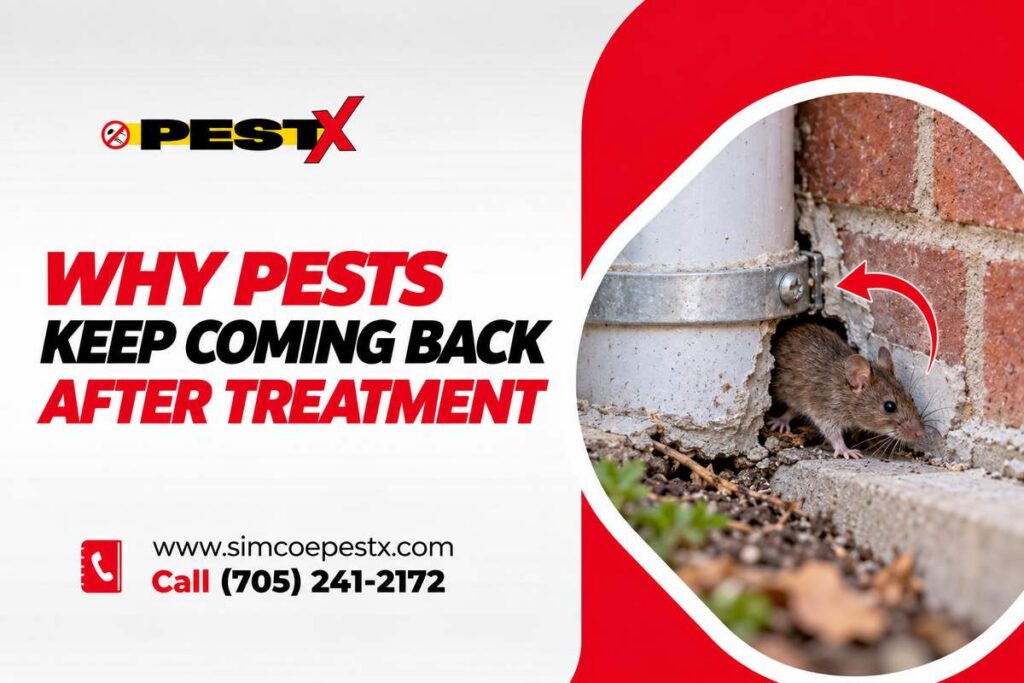
Why Do Pests Keep Coming Back After Treatment?
The pests could come back due to the fact that the initial process of treatment was unable to treat every part and stage of the infestation right away. Some pests could easily be seen and eradicated whereas others were hiding within wall cavities, nests, crevices, attics, basements, or any other hidden places.
There are some pests whose life cycle makes it possible for their eggs and immature stages to remain protected until even after the first treatment process; thus, leading to activity after several days or weeks.
Pest control may fail due to the fact that although the previous infestation has been taken care of, other pests could enter the premises.
For this reason, recurring pest activity can result from several factors, including:
- Hidden pests that were not immediately exposed to treatment
- Eggs or immature pest stages developing after treatment
- Large or established infestations that require more than one treatment
- Incomplete access to nests, colonies, or harbourage areas
- New pests entering the property
- Pest movement from adjoining units or neighbouring areas
- Conditions that continue to provide food, water, shelter, or nesting space
- Follow-up treatment or monitoring ending too soon
Does Seeing Pests Again Mean Pest Control Did Not Work?
Not necessarily. The presence of pests post-treatment doesn’t necessarily indicate failure in the pest control process.
There are products that take some time before showing results. For example, baits, residual treatment, traps, etc., might need pests to come into contact with the treatment or pass through the treated area before becoming affected.
Some pests could be hidden during the first treatment session but become visible afterward. This would make the problem seem persistent while, in fact, the total number of pests is reducing.
What matters most is the trend in the activity pattern. If the frequency of the sightings is reducing, then the treatment could still be doing its job effectively. Otherwise, additional evaluation may be required.
It also helps to distinguish between two situations:
- Continued pest activity: Pests from the original infestation remain active or continue emerging.
- Reinfestation: New pests enter after the previous population has been controlled.
Understanding which situation is occurring helps determine the appropriate next step.
Why Can Pest Activity Continue for a While After Treatment?
Treatment will not necessarily ensure that all pests will be eradicated simultaneously.
There may be cockroaches left in narrow cracks or within appliances. Ants may keep coming from an unknown colony to the treated areas. There may still be bed bugs hiding in harbourages. Rodents may continue moving through buildings despite the application of traps and exclusions.
Treatment may also alter the natural behavior of the pests. Pests, which used to stay hidden, may become more visible in some cases for a certain period.
It will depend on the species and type of the treatment as well as on many other factors.
Thus, there cannot be just one time span for all infestations.
What needs to be monitored is the reduction of activity, stability or increase in activity.
Why Are Follow-Up Treatments Sometimes Necessary?
Some infestations require more than one treatment because pest populations contain different life stages and may occupy several hidden areas.
A follow-up visit may be used to:
- Target pests that emerged after the first treatment
- Check whether traps, baits, or monitoring devices are still showing activity
- Identify previously unnoticed harbourage areas
- Adjust treatment based on where activity continues
- Confirm whether the pest population is declining
Follow-up treatment is particularly important when eggs or immature pests were protected during the first service.
The Infestation May Be Larger Than What You Can See
Can Pests Still Be Hiding After Treatment?
Yes. Many pests spend much of their time in protected harbourage areas.
For example:
- Cockroaches may hide in cracks, cabinets, wall spaces, and around appliances.
- Ants seen indoors may be workers travelling from a colony located elsewhere.
- Mice may nest inside walls, insulation, ceilings, or other concealed spaces.
- Bed bugs can remain inside narrow cracks, furniture joints, and other small hiding areas.
Some Barrie homes with basement, attic spaces, attached garages, decks, and wall cavities can include inspection challenges that cannot be accomplished without proper tools.
Why Do Hidden Nests and Colonies Matter?
Pest treatment may not solve the cause of the infestation.
In the case of an ant colony, production of worker ants may continue despite the death of numerous ants. In the same way, eliminating a mouse will not stop the infestation as long as more mice exist or there is a harborage area available to them.
This applies also to roaches and other pests that breed in their harborage areas.
It follows that pest control must target the infestation rather than the pests themselves.
Can Inaccessible Areas Make Treatment More Difficult?
In some cases, the pest harbourages will not be accessible immediately after the initial treatment.
The walls, insulation, cabinets, structural voids, and nearby units may make this impossible. The pests may also travel from one harbourage area to another, which makes it hard to locate their primary source of nesting or breeding. When the pests return to the same location time and again, then the professional should re-examine their sources.
Eggs and Pest Life Cycles Can Cause Activity to Return
Can Pest Eggs Survive the First Treatment?
Some insect eggs are shielded from certain forms of treatments.
In other words, cockroach egg capsules can have developing larvae inside them, and bed bug eggs can be present in tiny cracks and crevices. Once the eggs are hatched, homeowners can expect the return of some pests.
However, this is not an indication that a new colony of pests is established.
The returning pests can be part of the previous breeding process.
It is clear that different types of pests have a varying degree of response to treatments on eggs. Homeowners should adhere to the treatment program they have been provided.
How Do Pest Life Cycles Affect Treatment Results?
A recurring insect problem can sometimes follow this pattern:
- Active pests are exposed to the initial treatment.
- Hidden eggs or immature stages continue developing.
- New pests emerge.
- They encounter residual treatment, bait, traps, or a follow-up application.
- Monitoring shows whether the overall population is continuing to decline.
This is the reason why there are instances where some pest problems do not become clear right away following their control.
The critical issue is whether the pest situation is heading towards control or still developing.
When Does Continued Activity Become More Concerning?
Homeowners should pay closer attention when:
- Pest numbers increase instead of decreasing.
- Activity spreads into previously unaffected rooms.
- Fresh droppings, egg cases, nesting material, or gnawing appear.
- The same infestation repeatedly disappears and returns.
- Monitoring devices continue showing significant activity.
- Pest activity continues beyond the timeframe discussed with the pest-control provider.
At that point, further inspection may be needed to identify hidden harbourage, surviving populations, or a new source of infestation.
How to Reduce the Chance of Pests Coming Back
Follow the Recommended Treatment and Follow-Up Plan
Follow-up visits can be an important part of controlling a recurring infestation.
Homeowners should:
- Follow preparation and aftercare instructions.
- Leave monitoring devices, traps, or bait stations in place as directed.
- Avoid disturbing treated areas earlier than recommended.
- Complete scheduled follow-up treatments.
- Record where and when new pest activity appears.
- Tell the pest-control provider if activity increases or moves into new areas.
Avoid adding unrelated pesticides or moving bait stations without professional guidance. Doing so can sometimes interfere with the treatment strategy already in place.
Remove the Specific Condition Helping the Pest Return
If the same pest keeps returning, look for the condition allowing it to survive, breed, or enter again.
For example:
- Recurring mice may indicate an unresolved access point.
- Repeated cockroach activity may be connected to moisture or hidden harbourage.
- Returning ants may still have access to food sources or a nearby colony.
- Repeated bed bug activity may require inspection of additional hiding areas.
- Pests repeatedly appearing near shared walls may be coming from another connected area.
The goal is not to make a home completely unattractive to every possible pest. It is to correct the factors directly linked to the recurring problem.
Monitor for Evidence Instead of Relying Only on Visible Pests
A single pest sighting does not always provide enough information to determine whether an infestation is returning.
Watch for patterns and fresh evidence such as:
- New droppings.
- Increasing trap activity.
- Repeated ant trails.
- New gnaw marks.
- Shed insect skins.
- Egg cases.
- Fresh nesting material.
- Repeated sightings in the same location.
Monitoring can help determine whether pest numbers are decreasing, remaining stable, or increasing.
It can also help distinguish an isolated sighting from a recurring pest infestation that requires further attention.
When Should a Pest Problem Be Reassessed?
Consider contacting a qualified pest-control professional when:
- Pest numbers are not decreasing.
- Activity increases after initially improving.
- Pests begin appearing in new rooms.
- The same infestation repeatedly disappears and returns.
- Fresh evidence of nesting or breeding continues to appear.
- A hidden nest, colony, or harbourage area may still be present.
- Recommended follow-up treatment has not resolved the activity.
- Pests may be moving through shared areas in a townhouse, condominium, or multi-unit property.
If recurring activity continues, Barrie Pest Control Services can help identify whether the problem involves surviving pests, reinfestation, hidden harbourage, or unresolved entry points.
Homeowners can also review available Pest Control Services for the specific pest involved.
Where infestations repeatedly return, long-term pest prevention strategies can also help address conditions that allow recurring activity.