
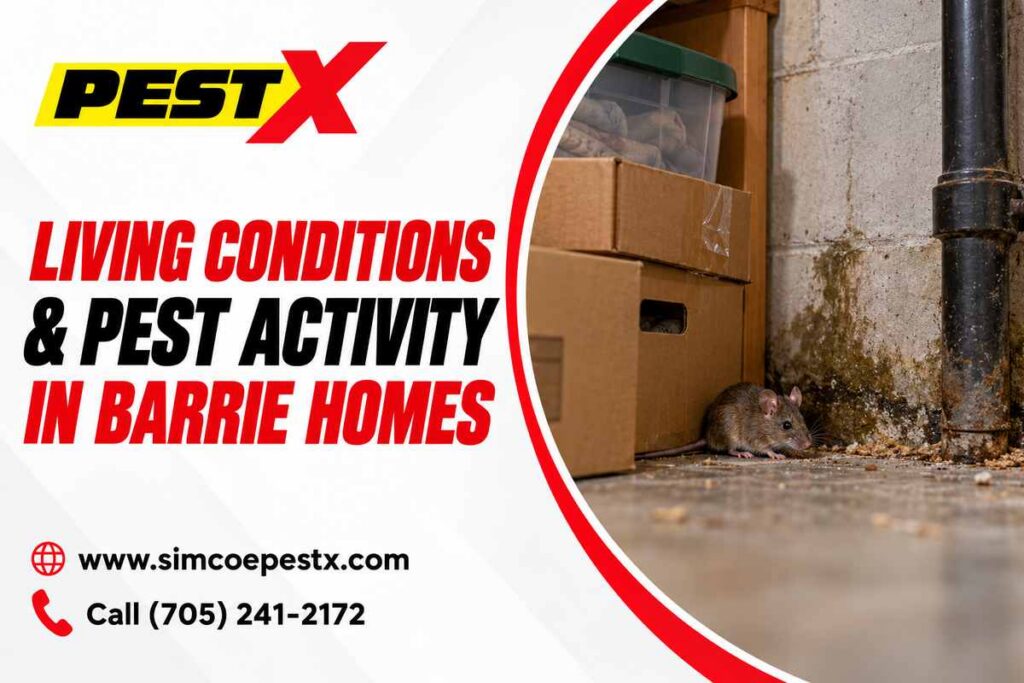
Why Living Conditions Can Increase Pest Activity
How Do Household Conditions Affect Pest Behaviour?
Household conditions can influence where pests travel, feed, hide, and establish nesting areas. A Barrie pest control expert can help identify which conditions may be contributing to recurring pest activity.
A simple way to understand this relationship is:
Condition → Resource provided → Pest response
For example:
- High humidity → more available moisture → some moisture-loving pests may remain active.
- Warm indoor temperatures → stable climate → certain pests can continue feeding and developing indoors.
- Clutter → protected harbourage → pests have more places to hide and may remain unnoticed.
- Accessible food → reliable feeding source → pests may repeatedly return to the same area.
- Rarely disturbed rooms → less human activity → nesting or hiding behaviour may continue for longer.
Which Parts of a Home Commonly Provide Pest-Friendly Conditions?
Certain parts of a home may offer several favourable conditions at the same time.
Homeowners should pay particular attention to:
- Basements and finished lower levels
- Utility and furnace rooms
- Laundry areas
- Kitchens and pantries
- Attached garages
- Attics
- Storage rooms
- Spaces beneath large appliances
- Areas around plumbing fixtures
In Barrie homes, basements and utility rooms can be exposed to moisture, condensation, poor ventilation, or long durations of inactivity. In attached garages and storage spaces, pests have areas that remain hidden.
How Temperature and Indoor Climate Influence Pest Activity
Can Warm Indoor Conditions Encourage Pests?
Indeed, warm indoor temperatures can allow certain pests to be active, provided that other conditions are favorable.
Cockroaches, for instance, can continue being active in warm kitchens and utility rooms or near appliances. Mice can move into sheltered indoor spaces when temperatures are cold, particularly where food and nesting sites are abundant.
Stored product pests can also be active inside dry food stored under suitable indoor conditions.
What matters most is often the combination of conditions rather than temperature alone.
A warm room without food, moisture, shelter, and pest entry is much less favorable than a warm place offering all of the above.
Why Do Stable Indoor Temperatures Matter to Pest Reproduction?
Consistent temperatures can help some pests continue normal activity indoors.
Depending on the species and surrounding conditions, stable indoor temperatures may allow pests to:
- Feed regularly
- Remain active for longer periods
- Develop through lifecycle stages
- Reproduce when food, moisture, and shelter are available
This is one of the reasons why pest activity may occur inside a heated building even when the weather outside becomes unfavourable for them.
Homeowners should not assume that lowering the thermostat will resolve their pest issues because indoor climate is just one aspect of the environment where pests live.
Which Warm Areas Should Homeowners Pay Attention To?
Warm areas deserve closer attention when they also provide food, moisture, shelter, or signs of pest activity.
Common examples include:
- Furnace and mechanical rooms
- Spaces around water heaters
- Kitchens
- Laundry rooms
- Heated basements
- Wall voids near plumbing or heating lines
- Warm storage areas
- Spaces behind refrigerators and other appliances
How Moisture, Humidity, and Poor Ventilation Create Pest-Friendly Conditions
Does High Humidity Increase Pest Activity?
High levels of humidity have a role to play in making some places suitable for pests that require moisture. Silverfish tend to thrive in environments that are humid and well-sheltered. Cockroaches could also be found around places with high moisture content, especially where there is access to food.
Possible signs of excess indoor moisture include:
- Condensation on windows or pipes
- Damp basement walls or floors
- Musty-smelling storage areas
- Moisture beneath sinks
- Recurring water around appliances
- Damp materials that take a long time to dry
Correcting the underlying moisture source can make these areas less favourable to pests.
How Can Poor Ventilation Make Pest Problems Worse?
Poor ventilation can allow moisture to remain trapped indoors.
The relationship is often straightforward:
Limited airflow → persistent condensation or humidity → more favourable conditions for moisture-loving pests
Moisture can be increased by bathrooms, laundry rooms, basements, attics, and utility rooms due to lack of proper circulation of air.
Items that are stored may also lead to the same problem. Items like boxes, furniture, or other things stored up against the basement wall can affect airflow.
Why Are Basements and Lower Levels Important?
Basements can provide several conditions that influence pest activity.
Depending on the property, lower levels may contain:
- Higher humidity
- Cooler foundation surfaces
- Condensation
- Floor drains
- Plumbing lines
- Utility equipment
- Stored belongings
- Areas that receive little regular activity
Barrie property owners may also face changing moisture conditions in the lower levels due to rain, melting snow, or drainage issues. This will vary greatly on a case-by-case basis.
The mere fact that the basement is underground does not automatically make it conducive to pests. The important point here is whether there is moisture, shelter, food, and access.
What Moisture Conditions Should Homeowners Correct?
Start with moisture that is persistent, unexplained, or recurring.
Homeowners can:
- Repair leaking pipes and fixtures
- Investigate recurring condensation
- Dry damp areas promptly
- Improve ventilation where appropriate
- Avoid allowing standing water to remain indoors
- Check beneath sinks and around appliances
- Investigate water entering basements
- Keep stored materials away from persistently damp surfaces
How Food, Waste, and Sanitation Affect Pest Survival
How Does Accessible Food Change Pest Activity?
Accessible food gives pests a reason to remain in or repeatedly visit a particular location.
For example:
- Ants may establish trails leading to recurring food sources.
- Cockroaches may forage around kitchens and appliances.
- Mice can feed on cereals, grains, pet food, and other stored products.
- Stored-product pests may develop directly inside flour, grains, cereals, spices, or similar foods.
Pests often stay hidden during periods of household activity and emerge when the space becomes quieter.
Can Small Amounts of Food Support Pest Activity?
Yes. Some pests can take advantage of food quantities that homeowners might consider insignificant.
A few crumbs beneath a refrigerator, residue around a stove, or pet food left out overnight may provide recurring feeding opportunities.
Dry food products can also become vulnerable when packaging is damaged or left open.
Useful steps include:
- Cleaning recurring food residue rather than only visible spills
- Storing dry foods in secure containers when practical
- Checking packages for holes or insect activity
- Cleaning beneath movable appliances
- Avoiding unnecessary overnight exposure of pet food
How Do Garbage and Recycling Conditions Affect Pests?
Waste and recycling areas can affect pest activity when they consistently provide food residue or organic material.
Potential problem conditions include:
- Overflowing indoor garbage
- Food residue inside recycling containers
- Unsealed food waste
- Containers stored for long periods before emptying
- Spilled liquids around bins
- Pet food or organic material near waste-storage areas
How Can Homeowners Reduce Food Availability?
Focus on the food sources that pests can repeatedly access.
Homeowners can:
- Keep pantry foods properly closed
- Clean food residue from counters and floors
- Check beneath refrigerators and stoves
- Store pet food securely
- Remove food waste regularly
- Clean significant residue from recycling containers
- Avoid leaving open food in rarely used rooms
- Inspect dry foods that have been stored for long periods
How Clutter, Storage, and Undisturbed Spaces Affect Pest Activity
Does Clutter Cause Pest Infestations?
Clutter does not create pests by itself.
However, it can make an existing pest problem easier to sustain or harder to detect.
Clutter may:
- Create protected hiding places
- Provide nesting materials
- Reduce visibility during inspections
- Make some areas difficult to clean
- Leave pests undisturbed for longer periods
The mice can build nests in storage. The cockroaches can hide in small cracks near the boxes and belongings. The silverfish can find shelter around paper and cardboard, especially where there is high humidity.
The spiders can create their webs in quiet places where they can catch their insects.
Clearing the clutter will make it easier to detect any changes in the pest activities.
Why Do Pests Favour Rarely Used Areas?
Frequently disturbed rooms give pests fewer opportunities to remain hidden.
By contrast, storage rooms, attics, garages, utility spaces, and basement corners may go days or weeks without close inspection.
These areas can provide:
- Darkness
- Minimal disturbance
- Stable temperatures
- Nesting material
- Concealed travel routes
- Nearby moisture or food in some cases
This is why homeowners sometimes discover pest evidence while moving boxes, reorganizing storage, or opening an area that has been untouched for months.
Occasionally inspecting rarely used spaces can help identify activity earlier.
How Do Storage Practices Affect Pest Harbourage?
The way belongings are stored can influence the number of concealed spaces available to pests.
Cardboard boxes are particularly useful to examine because they can provide cover and may remain untouched for long periods.
Potentially problematic storage arrangements include:
- Boxes stacked directly on basement floors
- Large amounts of cardboard kept indefinitely
- Items packed tightly against walls
- Dense storage beneath stairs
- Containers that have not been moved for months
- Belongings blocking access to corners or utility areas
How Can Homeowners Make Storage Areas Less Favourable to Pests?
Small changes can reduce shelter while making pest evidence easier to spot.
Consider:
- Removing unnecessary cardboard
- Keeping long-term storage organized
- Avoiding dense piles on floors
- Leaving inspection space along walls where practical
- Checking rarely moved items periodically
- Keeping storage areas dry and adequately ventilated
- Investigating droppings or damaged materials instead of simply cleaning them away
How Can Homeowners Make Living Conditions Less Favourable to Pests?
Practical steps include:
- Repair persistent plumbing leaks.
- Investigate condensation and recurring dampness.
- Improve ventilation where moisture regularly builds up.
- Keep food properly stored.
- Remove food residue from hard-to-reach areas.
- Manage garbage and recycling regularly.
- Reduce unnecessary cardboard and clutter.
- Organize long-term storage so areas can be inspected.
- Check basements, garages, utility rooms, and other rarely used spaces.
- Pay attention to repeated droppings, nesting material, insect sightings, or damaged food packaging.